
What is Conventional Powder Metallurgy Process?
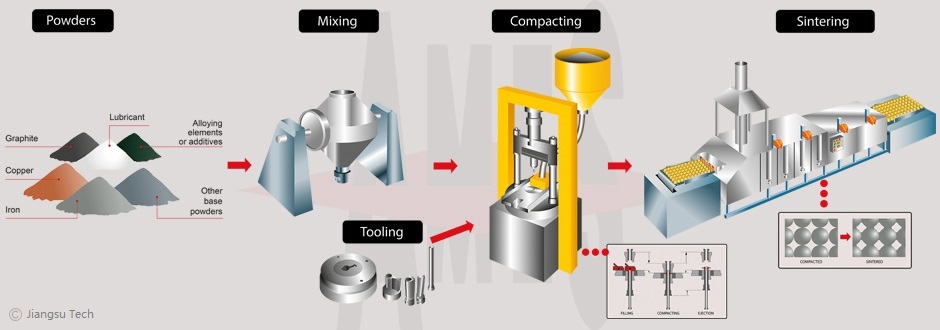
Powder Metallurgy, also known as press-and-sinter, consists of mixing elemental or alloy powders with lubricants or additives to produce a homogeneous mixture. Additives may help improve machinability, wear resistance, or lubricity of the part. The mixture is compacted in a die at pressures typically as low as 138 MPa (10 tsi) or as high as 965 MPa (70 tsi) depending on the density requirements of the part and the compressibility of the powder being compacted. In the typical sintering step, the green compact is conveyed through a controlled-atmosphere furnace. The parts are heated to a temperature below the melting point of the base metal, held at the sintering temperature, and then cooled as the part exits the furnace. Sintered parts have the strength levels to meet functional requirements of the components. Many PM parts are ready for use after sintering. Value-added properties or features can be obtained through repressing, forging, impregnation, machining, vibratory finishing, plating, shot-peening or heat treatment.
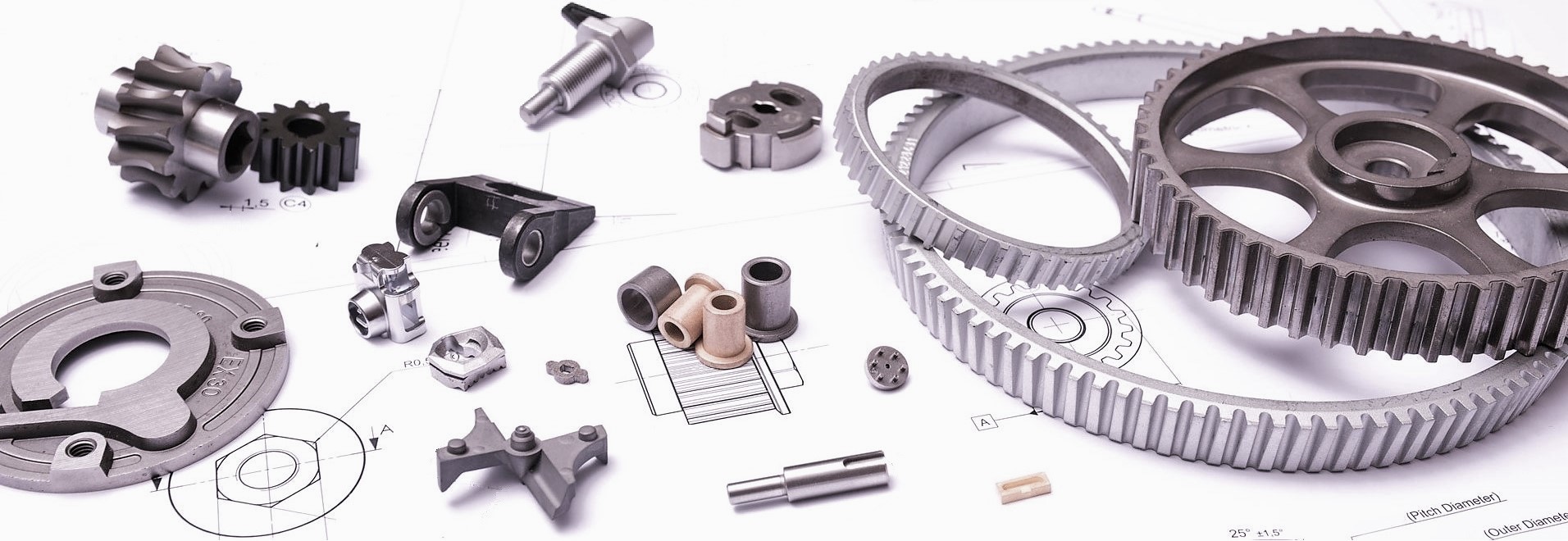
Most conventional PM parts weigh less than 5 pounds (2.27 kg). While many of the early PM parts, such as bushings and bearings, were very simple shapes, today’s sophisticated PM process produces components with complex contours and multiple levels.
Why Powder Metallurgy?
The powder metallurgy process provides a host of advantages over competing metalworking technologies. These all add up to part-to-part uniformity for improved product quality, shape and material flexibility, application versatility, and cost effectiveness.
Advantages of the Powder Metallurgy Process
•Minimizes machining by producing parts at, or close to, final dimensions
•Minimizes scrap losses by typically using more than 97% of the starting raw material in the finished part
•Permits a wide variety of alloy systems
•Produces good surface finish
•Provides materials which may be heat treated for increased strength or increased wear resistance
•Provides controlled porosity for self-lubrication or filtration
•Facilitates manufacture of complex or unique shapes which would be impractical or impossible with other metalworking processes
•Is suited to moderate- to high-volume component production requirements
•Offers long-term performance reliability in critical applications
•Is cost effective